

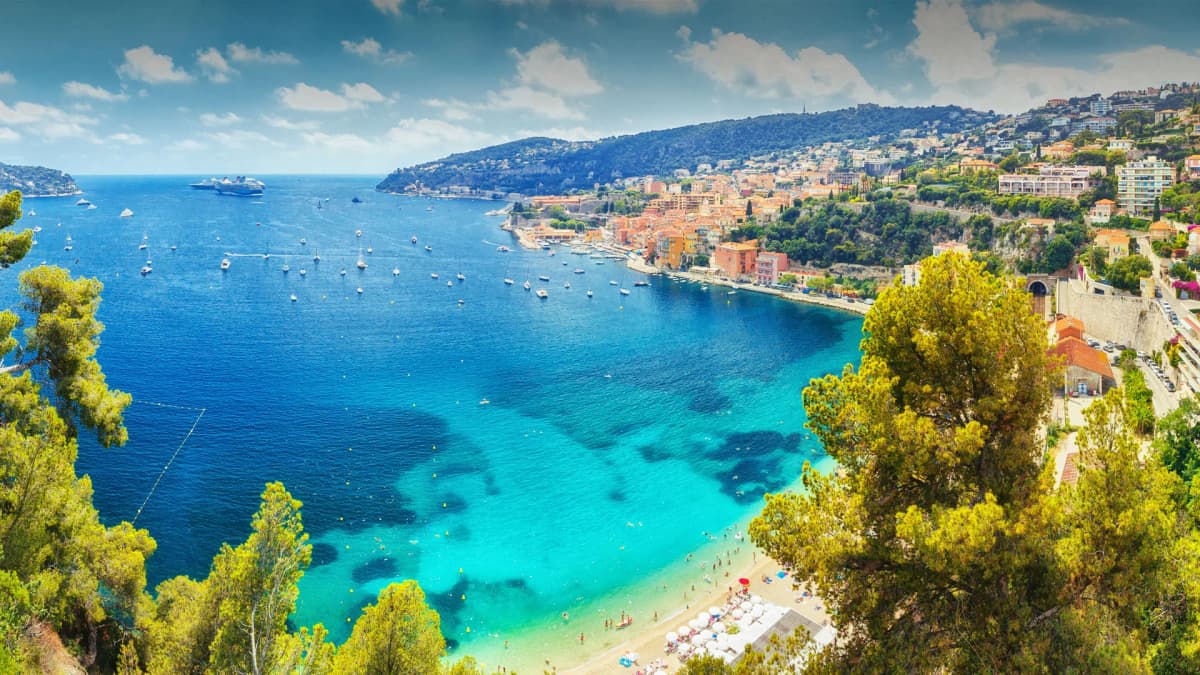
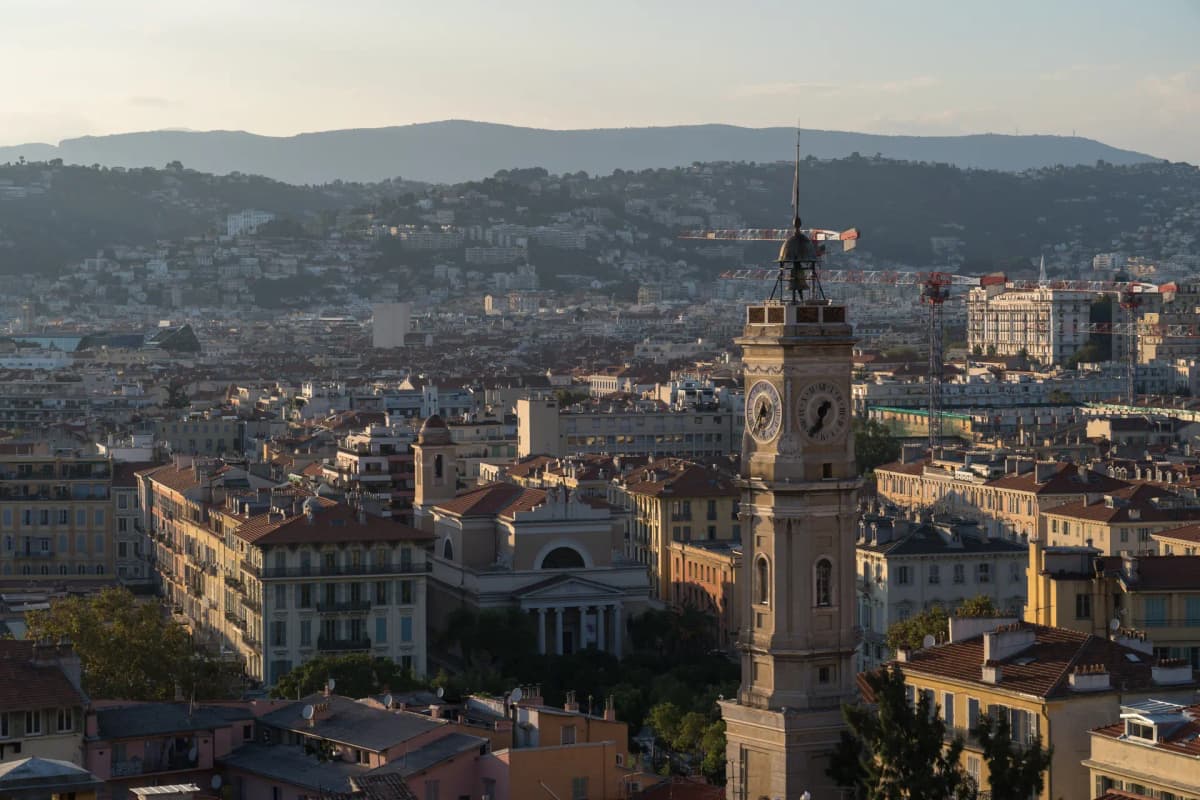
A morning on the Côte d'Azur smells of salt and orange trees, and this is precisely the perspective from which we will unfold Nice: not as a postcard, but as a city where imperial villas sit side by side with fishing boats at the pier.
The route is designed according to guide Raisa's list: from the wide Promenade des Anglais to the shady streets of Vieux-Nice. A car saves time between locations, while the stops give you enough time to stroll, photograph the facades, and ask questions — the "guide" or "driver-guide" format in a minibus is confirmed upon booking.
On the Promenade des Anglais, it is easy to understand why aristocrats used to come here for the winter: the sea on one side, a parade of hotels on the other. By the Negresco, we will stop at the legendary facade; at Masséna and Garibaldi, different eras of the same nation exist within the same space.
By the port and on Mont Boron, a different scale reveals itself — yachts, cliffs, and a panorama of the bay. The imperial district and Cimiez will recall the Roman heritage and how Nice became the "winter capital" of Europe. The Saint-Nicolas Cathedral is a rare Orthodox accent in the west of France.
Along the route you will learn:
The price and exact duration are not specified on the card — we will agree on them separately; the excursion is conducted in Russian, without rushing and with an emphasis on living stories rather than dry dates.
We do not chase checkmarks in a guidebook: every stop is a separate chapter that the guide connects to the next, so that by the end of the day a cohesive map of the city emerges. Comfortable shoes for walking in Vieux-Nice and a light jacket for the wind on Boron will make the day more comfortable; a camera will come in handy both at the port and at the viewpoints.
Nice reveals itself to those who notice details: the color of the curtains on a Masséna balcony, the sound of church bells from Cimiez, the scent of socca on the corner of the old town. The private format allows you to linger wherever you wish — by the monument to Catherine Ségurane or at the gates of the Saint-Nicolas Cathedral — without the pressure of a group.
If you want to feel Nice in a single breath — from the bourgeois promenade to the market aromas of Vieux-Nice — this route is put together precisely for such an immersion. See you on the Côte d'Azur!
The sea breeze here smells of salt and old stone, and the pavement beneath your feet crickets with a century of history. Established in the 19th century, this promenade has become the hallmark of Nice, where the paths of locals and visitors from all over the world converge. They say it was right here in 1806 that Napoleon first saw the Côte d'Azur and remained deeply impressed. Today, along La Promenade des Anglais, you will feel the rhythm of the city: from the leisurely movement of boats to the bustling flower market.
The white columns and blue-and-gold accents of this building draw the eye like a magnet. Opened in 1912, the Negresco became a place where movie stars, writers, and kings stayed. Inside, the atmosphere of the Belle Époque is preserved: chandeliers, marble, and the scent of fresh flowers in the lobby. Local legend has it that Einstein himself once stayed in one of the rooms, pondering his theory of relativity. Here, every corner breathes history and luxury.
In the center of the old town lies the square named after Marshal Massena, a hero of the Napoleonic Wars. Fountains, park areas, and cafes create a cozy atmosphere where you can take a break from walking. From here, you can enjoy a view of St. Nicholas Church and the ancient streets. In the shade of the cypress trees, locals often gather for a cup of coffee to discuss city news. Here, time flows more slowly, and the air is filled with the aroma of fresh pastries.
In the center of Nice, at Place Massena, stands the Garibaldi monument, presented by Italian emigrants. The figure of the hero of two nations faces the sea, as if preserving the connection between the shores. Nearby, on the corner, hides a historic pastry cafe where fresh croissants are baked every morning. Locals believe that if you sit on the bench at the foot of the monument and make a wish, it will come true. The architecture of the square combines 19th-century classicism with modern elements.
In an old cemetery on the outskirts of Nice rests Catharine Segurane, whose life became a legend of the Cote d'Azur. According to local lore, she was a sorceress capable of foretelling the future and healing ailments. Her grave is surrounded by myths of magic and secret rituals passed down through generations. Today, visitors come here not only for the tranquil atmosphere but also to search for mysterious symbols carved on the tombstone. Catherine's story remains a vibrant part of the region's folklore.
The port of Nice is the heart of the city, where luxury yachts meet traditional fishing boats. Here, the air smells of sea salt, fresh fish, and coffee from nearby cafes. A stroll along the promenade offers views of majestic vessels and the lively activity of port workers. In the evening, the port transforms: lights reflect on the water, and music drifts from open terraces. This is a place where maritime history intertwines with modern pleasures.
This cliff offers a breathtaking view. Below, the Mediterranean Sea sparkles, and beyond it, the Alps fade into the haze. The air is filled with the scent of sea salt and magnolia. Local elders sit on the benches, watching the port life. It is believed that Napoleon III admired his Nice from this very spot.
Narrow streets intertwine into a labyrinth where time flows differently. The porous walls have absorbed the warmth of the southern sun. Noble guests of Empress Eugénie once lived here. Quiet courtyards with pink flowers hide in the shade of the arcades. The atmosphere of tsarist Nice is still felt in every stone of this quarter.
The snow-white facade gleams against the dark roofs of the old town. Inside, a cool silence prevails, broken only by the rustle of prayers. The mosaics on the walls shimmer with gold with every ray of light. This temple preserves the memory of Greek settlers who founded Nice. The architecture combines Byzantine austerity with French elegance.
Here time flows slower than in the neighboring Ville. Narrow cobblestone streets lead to the house where Salvador Dalí was born. Locals say the artist ran barefoot along these paths, collecting seashells for his early works. The atmosphere is saturated with the scent of Provençal herbs and fresh pastries from bakeries operating on ancient recipes. Looking at the facades, one can notice how nineteenth-century architecture has survived untouched by tourist hustle. This is a place for those who seek the authentic spirit of Nice rather than postcard views from the promenade. The descent to the sea through green slopes gives a sense of escape from city life.
The heart of Nice beats on the steep slopes near the Church of Notre-Dame-de-l'Assomption. This is where uprisings against the Genoese Republic began. Narrow alleys form a labyrinth, revealing views of the sea. Massena Square once held an arena for gladiatorial combat. Today, peace reigns here, disturbed only by the ringing of church bells. Walking through these streets is a journey back to the era when Nice was a bustling port rather than a resort. Every stone preserves the memory of spice traders and sailors.